
)
Mastering the art of the short-handed grind is often the "ah-ha" moment for aspiring pros. If you’ve spent your life waiting for pocket Aces at a 9-max table, moving to a 6-max table will feel like walking out of a library and into a high-speed chase. It’s loud, it’s fast, and if you aren’t ready to fight for every pot, it will chew you up.
TLDR: 6-Max Poker Strategy
Key Shift: Blinds orbit 30% faster; you must play a wider range of hands to offset the cost of blinds.
The Core Weapon: The 3-bet is the most effective tool to punish wide openers and take control of the pot pre-flop.
Positional Strategy: Success is dictated by the "Button vs. Blinds" battle. Use the Button to steal relentlessly and the Big Blind to defend creatively.
The LAG Approach: Aim for a Loose-Aggressive (LAG) style—playing more hands but with calculated, high-pressure aggression.
What is 6-Max Poker Short Handed?
At its core, 6-max poker short handed play refers to any game where no more than six players are dealt into a hand. While traditional full ring games often feature nine or even ten players, the 6-max format removes the "early positions"—leaving only the Lojack, Hijack, Cutoff, Button, Small Blind, and Big Blind.
This seemingly small change in the number of handed tables completely rewrites the mathematical DNA of the game.
In a full ring environment, you can afford to be a "nit," playing only the top 10% of hands because the blinds take a long time to reach you. In 6-max games, the blinds orbit the table with relentless speed. You simply cannot wait for premium cards; you have to get your hands dirty with a wider range of starters.
Why Short Handed Games Require a Strategy Shift
The primary difference between full ring and short handed poker is the frequency of confrontation. Because there are fewer players to wake up with a monster hand, the average strength of a winning hand decreases significantly. A pair of Jacks is a powerhouse in 6-max, whereas it might be a liability against a four-bet in a nine-max game.
| Feature | Full Ring (9-10 players) | 6-Max (Short-Handed) |
|---|---|---|
| Game Pace | Slower (70-80 hands/hour online) | Blistering (90-110+ hands/hour online) |
| Average VPIP* | Tight (approx. 12% – 18%) | Loose (approx. 22% – 28%) |
| Blind Frequency | Every 9–10 hands | Every 6 hands |
| Key Positions | UTG, MP, HJ, CO, BTN, SB, BB | LJ, HJ, CO, BTN, SB, BB |
| Hand Strength | High (Premium pairs/broadways) | Relative (Middle pairs/suited connectors) |
| Variance | Moderate | High |
The Math of Aggression
In online poker, 6-max is the gold standard for cash games because it generates more rake and more action. To survive, you must transition from a passive "calling station" mindset to one of calculated aggression. You are forced to play more hands, which inherently increases your variance. You’ll win bigger pots, but you’ll also face more difficult decisions on the turn and river.
6 Max Poker Strategy
Success in 6-max poker strategy isn't about being a "maniac"; it's about being a "LAG" (Loose-Aggressive) player who knows exactly when to apply the brakes.
1. Opening a Wider Range
Since the "junk" positions are gone, your opening hand range should reflect a more active approach. From the Cutoff or Button, you should often be opening 35% to 50% of your hands. If the table is playing tight, you steal the blinds; if they fight back, you use your positional awareness to outplay them post-flop.
6-Max Table for Cash Games
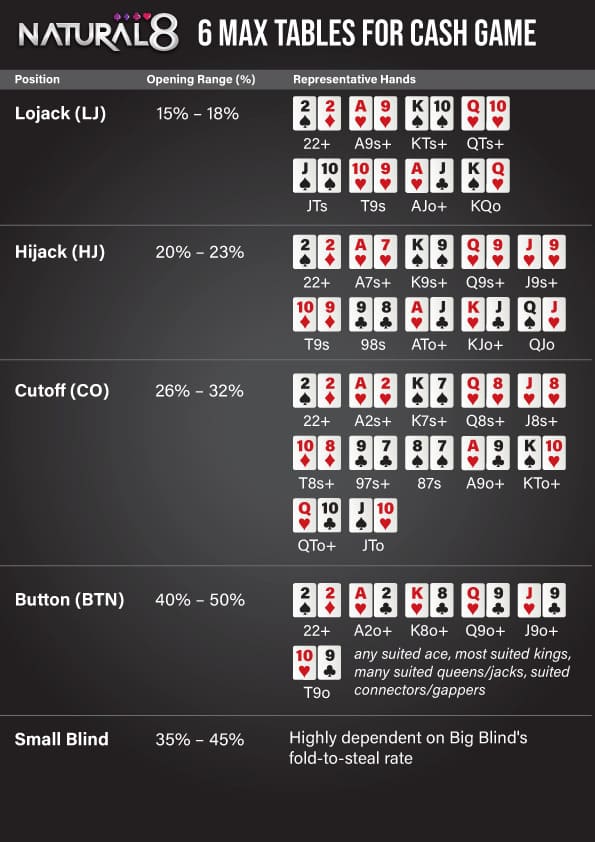 In a 100bb (big blind) cash game environment, your opening ranges must balance the need for aggression with the reality of rake and post-flop playability. Unlike full-ring games, where you can wait for premium holdings, the 6-max format requires you to "fan out" your range as you move closer to the Button.
6-Max Table for Tournaments
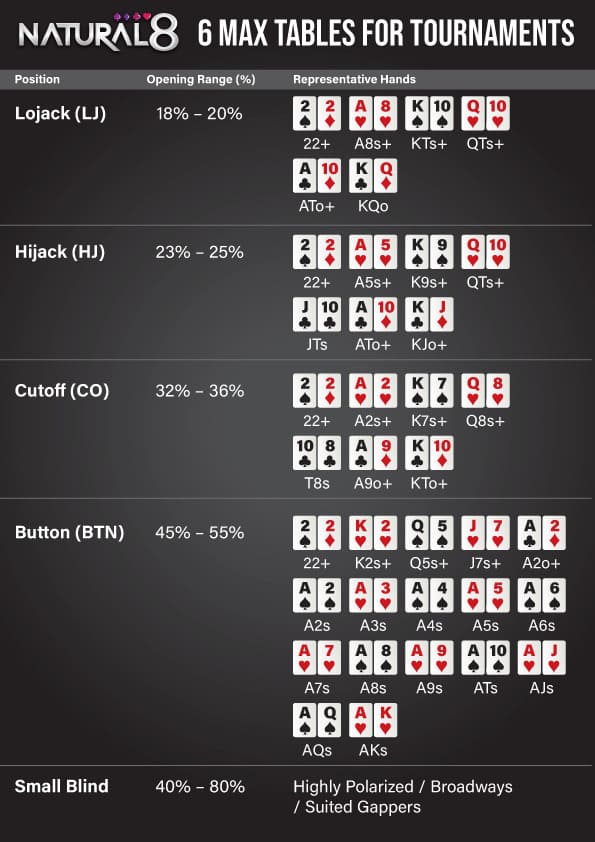 In tournament play, the presence of antes increases the "dead money" in the pot. This shifts your mathematical requirement, allowing you to open slightly wider than in a standard cash game to maintain your chip stack.
Key Tournament Adjustments (The "Why")
The Ante Factor: In a tournament, the pot starts at ~2.5bb (instead of 1.5bb). This "dead money" makes it mathematically correct to fight for the pot with weaker hands than you would in a cash game.
Stack Volatility: At 40bb, you have enough to play "real poker," but you must be careful with "trap hands" like K-J offsuit. If you open and get shoved on (3-bet jam), you are in a miserable spot.
Survival vs. Accumulation: In the early levels, stick to the cash ranges. Once you are at mid or late stages, switch to the table above to ensure your stack doesn't get blinded away.
2. The Power of the 3-Bet
In short hand play, the 3-bet (re-raising pre-flop) is your most potent weapon. It serves two purposes: it builds a pot when you have a value hand, and it forces "fold equity" against players who are opening too many weak hands. A high 3-bet percentage is the hallmark of an elite poker strategy in modern 6-max cash games.
Let’s look at a hand that I played:
The Scenario: Online 6-Max Cash
My Hand: A5 (Button)
The Action: A standard "Reg" opens to 2.5bb from the Hijack. The Cutoff folds. It’s on me.
My Thought Process: In a full-ring game, I’d often fold A5s or if the situation calls for it, I’d call and play cautiously. But in 6-max, it is the ultimate 3-bet bluff candidate. Here’s why:
Blockers: Holding an Ace makes it mathematically less likely my opponent has an AK or AA.
Post-flop Playability: If they call, I have the best "wheel" draw potential (A-2-3-4-5 straight) and nut-flush potential.
The Result:
I 3-bet to 8.5bb. The blinds fold, and the Hijack (who is opening ~22% of hands) now faces a miserable decision out of position. He thinks for five seconds and folds.
I didn't win because I had the best hand; I won because I realized his opening range was too "wide" to defend against a 3-bet. Even if he called, I had the initiative and position to take the pot on most low-board textures. That is the 6-max edge in a nutshell.
3. Positional Dominance
Position is everything. In short handed poker, being "on the button" is like having a superpower. You get to see how everyone else reacts before you commit a single chip post-flop. This allows you to utilize check raises or delayed continuation bets to manipulate the bet size and control the narrative of the hand.
Advanced Tactics: Blind Pressure and Post-Flop Adaptability
The real war in 6-max is fought between the Button and the Big Blind. This is where the most money is won and lost.
Attacking the Blinds
If the players in the blinds are playing too cautiously, you should be raising almost any two cards from the Button. However, if the poker players in the blinds are aggressive 3-betters, you must tighten up and start 4-betting light to protect your range. This constant leveling war is what makes short handed games so mentally taxing and rewarding.
Post-Flop Creativity
Because ranges are wider, you will often find yourself in "marginal" situations. You might have middle pair on a coordinated board, facing a heavy lead.
Don't panic. Analyze the opponent's bet size.
Consider their tendencies—do they over-bluff?
Mastering short handed poker strategy means becoming comfortable with uncertainty. You have to be willing to make "hero calls" or "hero folds" based on subtle physical or timing tells that wouldn't matter in a full ring game.
Structure and Pace: What to Expect
The pace of 6-max poker is blistering. You will play roughly 30% more hands per hour than you would at a full ring table. This increased volume means your mistakes are magnified. If you have a "leak" in your game—like calling too many 3-bets out of position—it will drain your bankroll much faster in a 6-max setting.
Pro Tip: Focus on "Table Selection." Even in a fast-paced environment, finding a table with one or two "fish" (weak players) is more important than your specific technical skills.
Conclusion
Stepping away from the full-ring comfort zone and into the world of 6-max poker is the ultimate test of a player's psychological and technical fortitude.
It is a format that rewards the bold and punishes the hesitant, requiring a delicate balance between reckless aggression and disciplined math. By expanding your hand range, mastering the art of the 3-bet, and respecting the immense power of position, you transform the game from a wait-for-cards marathon into a high-stakes chess match.
The learning curve is steep, and the variance can be a rollercoaster, but for those willing to adapt, the rewards—and the level of play—are unparalleled. Now, it's time to take these principles to the online poker streets and start winning those pots that others are too afraid to contest.
Frequently Asked Questions
Is 6-max poker more profitable than full ring?
Yes, 6-max poker is generally more profitable than full ring because the faster pace allows skilled players to realize their edge over more hands per hour. Because the game moves faster and involves more marginal decisions, a skilled player can realize a higher win rate per hour, provided they can handle the increased variance and emotional swings associated with the format.
How should my starting hand requirements change?
You must significantly widen your hand range. In a full ring game, you might fold K-T offsuit from the middle position. In 6-max poker, that same hand becomes a standard open from almost any position. The goal is to realize equity more often while utilizing your position to punish players who are playing too "tight" or "nitty."
Why is 3-betting so important in short-handed play?
3-betting prevents your opponents from seeing cheap flops and realizing their equity. In short handed poker, players open wider, which means their ranges are "capped" or weak. By 3-betting, you put them in a position where they must either fold, call out of position, or 4-bet bluff—all of which are difficult to execute correctly.
What is the biggest mistake new 6-max players make?
The most common error is failing to adjust to aggression. Many players move from full ring to 6-max and continue playing a "wait-for-premiums" style. This allows aggressive opponents to steal their blinds repeatedly. Conversely, some players over-adjust and become "maniacs," spewing chips by overvaluing weak pairs or drawing hands in inflated pots.
How do I handle the high variance in 6-max?
Variance is a byproduct of playing a wider range and more frequent large pots. To manage this, you need a sturdier bankroll—typically 40 to 50 buy-ins for the stake you are playing. Focus on making the "plus-EV" (expected value) decision rather than the short-term result, and don't be afraid to step down in stakes if a downswing hits.
Should I use different bet sizes in short handed games?
Yes. Because ranges are wider, your bet size should be used as a tool to manipulate your opponent’s range. For example, smaller "c-bets" (continuation bets) are often more effective on dry boards to pick up the pot cheaply, while larger bets are necessary on "wet" boards where you need to protect your hand against a multitude of draws.
)
Shane C
Shane is a content writer with over 10 years of writing experience. He specializes in poker and casino games and has been chasing the ultimate poker dream and the excitement of hero calls for the last 15 years! Admittedly, he has yet to win any APT nor WSOP title, but he's not giving up!
)
)
)
)
)
)
)