
)
- What Should You Do When You Hit Quads on the Turn?
- What Are Quads in Poker?
- Why Is Playing the Turn With Quads More Complicated Than It Looks?
- Should You Slow Play Quads on the Turn?
- When Should You Bet Quads for Value on the Turn?
- How Big Should You Bet With Quads on the Turn?
- How Does Board Texture Change Poker Quads Strategy?
- Should You Check-Raise Quads on the Turn?
- Should You Build the Pot Immediately With Four of a Kind?
- How Should Opponent Range Affect Your Turn Strategy?
- What About Quads on a Board With Possible Straight Flushes?
- Can Quads on the Turn Still Lose on the River?
- How Does Position Change Your Strategy With Quads?
- How Does Stack Depth Change Turn Strategy With Quads?
- Does Tournament Poker Change How You Should Play Quads?
- The Biggest Mistakes Players Make After Turning Quads
- A Simple Poker Quads Strategy Checklist
- Final Thoughts: When You Hit Quads, Think About Their Hand Rather Than Yours
- FAQs About Quads in Poker
Hitting quads in poker on the turn creates one of those rare moments when your first instinct is probably something like: Please, somebody have a hand.
You have four cards of the same rank. You are sitting on one of the strongest possible poker hands. And unless an unusual river produces a higher four of a kind or a straight flush becomes possible, you are in outstanding shape.
The difficult part is no longer making your hand.
It is getting paid.
A good poker quads strategy is less about protecting your hand and much more about understanding what your opponent can realistically call, bet, or raise with. Sometimes that means checking and letting an aggressive player hang themselves. Sometimes it means betting immediately because your opponent has too many strong second-best hands to risk giving them a free card.
And sometimes the best play is surprisingly simple: put money into the pot before the river kills your action.
What Should You Do When You Hit Quads on the Turn?
When you make quads on the turn, your main goal should usually be to maximize value rather than protect your hand. Start by asking three questions: how strong is your opponent's range, how likely are they to bet if checked to, and what river cards could reduce the amount they are willing to pay?
That last question matters more than it first appears.
Imagine you hold 7 7 on:
7 K 2 7
You have quad sevens.
Your opponent cannot hold another seven because all four sevens are accounted for. But they can still have hands such as KK, 22, Kx, pocket aces, heart draws, or stubborn pocket pairs.
If they have kings, deuces, or another pocket pair that interacts strongly with the board, there may already be plenty of value available.
Now compare that with holding A 7 on:
7 7 7 K
You also have quad sevens, but the situation is completely different. Three sevens are sitting in plain sight. Every opponent knows they already have at least trips from the board, and your hole card contains the only remaining seven.
Their range contains plenty of hands that look respectable but are actually drawing nearly dead against you.
Same hand ranking. Different strategy.
That is why playing the turn well requires more than looking at the words "four of a kind."
What Are Quads in Poker?
Quads are four cards of the same rank combined with one additional card to form a five-card poker hand. They are also known as four of a kind.
For example:
Q Q Q Q A is four of a kind, queens, with an ace kicker.
Under standard poker hand rankings, four of a kind beats a full house, flush, straight, three of a kind, two pair, one pair, and high card. Only a straight flush can beat ordinary quads; a royal flush is simply the highest-ranking form of straight flush.
So when somebody asks, "What hand beats a full house?", quads are one very clear answer.
The important detail, however, is that not every set of quads has the same value.
Quad kings beat quad queens. Quad queens beat quad jacks, and so on. In situations where the four community cards themselves create the same quads for everyone, the fifth card—the kicker—can decide the winner.
Why Is Playing the Turn With Quads More Complicated Than It Looks?
The turn is where value can quietly disappear if you become too clever.
Players often hit an enormous hand and immediately think, I have to slow play this.
Not necessarily.
A strong hand does not automatically become more profitable because you check it. Your opponent still needs a reason to put chips into the middle.
Consider what happens when you check quads against a passive opponent holding the top pair. They may happily check behind. Then a dangerous-looking river card arrives, you finally bet, and suddenly that same player finds a fold.
You gave away an entire betting street.
That is expensive.
Good turn strategy poker is built around extracting value from the range your opponent has now, rather than hoping they magically improve into something willing to pay you later.
The question is therefore not: "How can I hide how strong I am?"
A better question is: "Which action makes my opponent put the most money into the pot over the turn and river?"
That subtle change in thinking is huge.
Should You Slow Play Quads on the Turn?
Slow playing quads can be excellent when your opponent is aggressive, their range is relatively weak, and betting would force out hands that might bluff later.
But slow playing should have a purpose.
Do not check simply because checking looks sneaky.
A turn check becomes attractive when:
Your opponent frequently attacks weakness.
Their range contains many bluffs and weak hands.
You block most of the hands that could call a large bet.
The board is so dry that few river cards will damage your action.
Your opponent has the betting lead and is likely to continue.
Stack sizes still allow you to build a large pot on the river.
Imagine your opponent raised preflop, bet the flop, and now you turn quads on a relatively dry board.
If that player has a high continuation-bet frequency and enjoys applying pressure, checking to them can be beautiful. You are not giving away value because you expect them to provide the bet themselves.
Against someone who checks back medium strength hands constantly, though?
Bet.
Waiting for a passive player to build the pot for you is usually wishful thinking.
When Should You Bet Quads for Value on the Turn?
Betting quads is usually best when your opponent's range contains plenty of hands that can call immediately.
This is particularly important when they may hold:
A full house
An overpair
Top pair with a strong kicker
A strong draw
A combination draw
A pocket pair unlikely to fold to a modest bet
The temptation with quads is to think, Nothing can hurt me, so I can wait.
But your hand's safety and your ability to get paid are two different things.
Suppose you have 8 8 and the board is:
8 J J 8
You have quad eights.
A player holding a jack already has a full house. Pocket aces or kings may also feel extremely strong. Pocket jacks would have higher quads and beat you, but that is an exceptionally narrow part of the range.
Against the vast majority of continuing hands, this is exactly the type of situation where building the pot makes sense.
Your opponent does not merely have bluff-catchers. They can have genuinely powerful poker hands that are still second best.
Give those hands a chance to pay you.
How Big Should You Bet With Quads on the Turn?
Your bet size should depend on what you expect your opponent to continue with, not on how excited you are about your hand.
That sounds obvious. At the table, it is surprisingly easy to forget.
If an opponent's range is weak, a smaller bet may produce more total value. Betting around a quarter to two-fifths of the pot can keep in ace-high hands, pocket pairs, weak trips, and curious bluff-catchers on certain boards.
If their range is stronger and contains full houses, trips, premium overpairs, or powerful draws, a larger bet becomes easier to justify.
Here is a useful practical framework:
| Situation | Turn Approach | Why |
|---|---|---|
| Opponent has many weak bluff-catchers | Small value bet | Keep their calling range wide |
| Opponent has many full houses or trips | Medium-to-large bet | Strong hands can pay more |
| Opponent is highly aggressive | Check more often | Give them room to bluff |
| Opponent is passive | Bet yourself | Do not expect them to build the pot |
| Stack-to-pot ratio is low | Start building immediately | Easier to get stacks in by river |
| Stack-to-pot ratio is very deep | Plan turn and river together | You may need two substantial bets |
These are practical guidelines rather than automatic rules. Poker is a range game. Your sizing should reflect what that particular player can reach the river with.
How Does Board Texture Change Poker Quads Strategy?
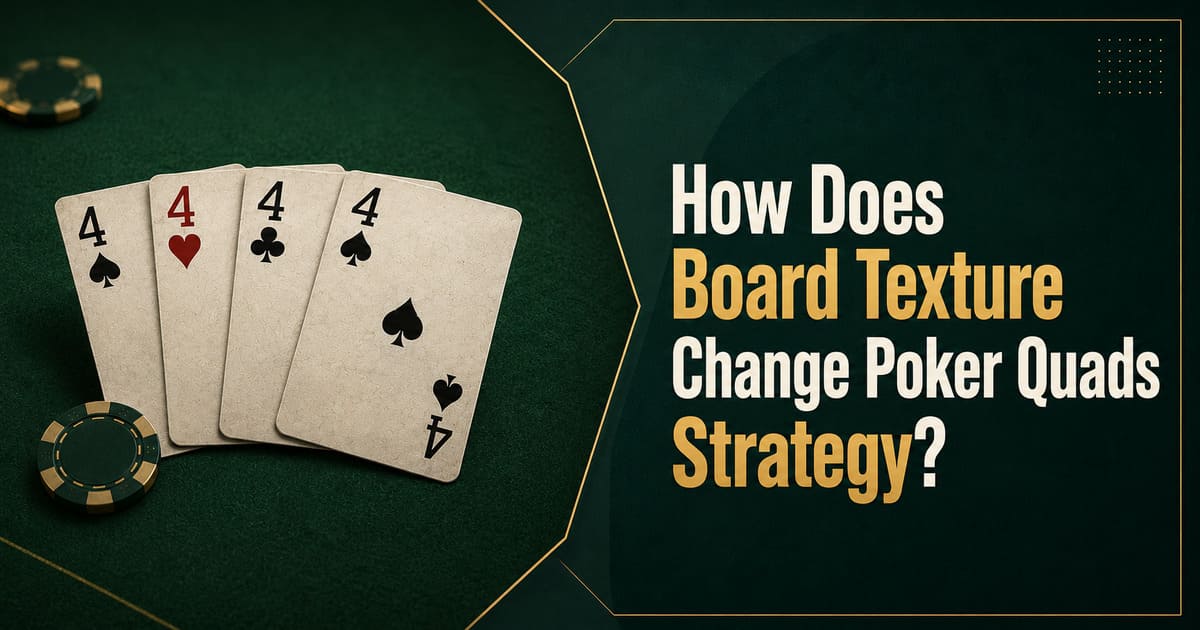 Board texture determines how many second-best hands your opponent can have—and that determines how aggressively you should chase value.
This is one of the most important ideas in poker quads strategy.
Quads Made With a Pocket Pair
Holding a pocket pair and seeing the other two cards of the same rank appear on the board can be extremely profitable.
For example:
Your hand: 6 6Board: 6 Q 3 6
You have quad sixes.
Because you hold both remaining sixes, nobody else can have a six. Yet opponents can have queens, pocket threes, overpairs, flush draws, and occasionally a full house made with another pocket pair.
That is a range with potential customers.
Betting can make plenty of sense.
Quads Made With One Hole Card
Now consider:
Your hand: K 9Board: 9 9 9 K
You hold the last nine.
Your opponent cannot have quads. Most of their range consists of trips with a kicker, while pocket kings would make a full house.
Here, your quads are extremely well disguised in one sense—the opponent cannot see your fourth nine—but the board itself looks terrifying.
Smaller bets can work well because an opponent holding an ace, queen, or pocket pair may convince themselves they are chopping or still strong enough to call.
Draw-Heavy Boards
Draw-heavy textures create urgency even when your own hand needs almost no protection.
Why?
Because the draw is part of your opponent's current willingness to continue.
A flush draw may happily call on the turn. If the river misses, that same hand becomes worthless.
A straight draw may bluff the river, which creates an argument for checking against aggressive players. Against passive players, however, taking the guaranteed turn call can be much better than hoping for a bluff that never comes.
The river card does not have to beat you to cost you money.
It only has to make your opponent stop paying.
Should You Check-Raise Quads on the Turn?
A turn check-raise with quads works best when your opponent is likely to bet a wide range and continue against the raise with enough strong hands.
This can be devastating against aggressive players.
Imagine your opponent has shown a willingness to barrel scare cards, value bet thinly, and attack checks. You turn quads out of position.
Checking gives them rope.
Once they bet, the next question is whether raising now produces more value than calling and trapping again.
Raise when their betting range contains hands that can withstand pressure: full houses, trips, overpairs, strong top pairs, and high-equity draws.
Call more often when their bet is heavily weighted toward bluffs that would disappear immediately against a raise.
Do not automatically check-raise just because your hand is enormous.
When your opponent is bluffing with almost nothing, letting them reach the river with that almost-nothing may be far more profitable.
Should You Build the Pot Immediately With Four of a Kind?
Building the pot early becomes increasingly important when stacks are deep enough that one river bet will not get enough money into the middle.
This is where pot geometry matters.
Suppose the pot is $40 on the turn and both players still have $300 behind.
If you check and your opponent checks behind, you reach the river with the same $40 pot and $300 stacks.
Even a pot-sized river bet now wins only another $40 when called.
Contrast that with betting $30 on the turn and getting called. The river pot becomes roughly $100, giving you room to make a much larger final value bet.
One seemingly innocent turn check can therefore reduce your possible river winnings dramatically.
Strong players think at least one street ahead.
When playing the turn, ask yourself what pot you want to create for the river.
How Should Opponent Range Affect Your Turn Strategy?
Your opponent's range matters more than the absolute strength of your own cards once you make quads.
You already know your hand is enormous.
What matters now is theirs.
Against a recreational player who overvalues top pair, bet more freely. They may call with hands that stronger opponents release.
Against a tight regular whose range reaching the turn is already strong, larger bets may work because they arrive with more full houses, trips, overpairs, and premium bluff-catchers.
Against an aggressive player capable of firing multiple barrels, checking becomes more appealing.
Against a calling station, fancy traps are unnecessary.
This is one of poker's recurring lessons: the same cards can demand different actions against different people.
Quads do not change that.
If anything, they make opponent profiling even more valuable because protection is rarely your main concern. Almost every decision becomes an exercise in extraction.
What About Quads on a Board With Possible Straight Flushes?
Quads are exceptionally strong, but they are not always the nuts.
In traditional high-hand poker games, four of a kind sits below a straight flush in the ranking hierarchy. PokerNews and PokerStars both list quads above a full house but below straight flushes in standard rankings.
That matters when a coordinated board develops.
Suppose a river card completes four connected cards of the same suit on the board. Depending on the exact cards and your opponent's hole cards, a straight flush may become possible.
You should therefore avoid falling into the mental trap of thinking:
"I have quads. I literally cannot lose."
Usually, you are an overwhelming favorite.
But usually is not always.
Before committing an enormous river stack, take two seconds and read the final board again.
Can Quads on the Turn Still Lose on the River?
Yes—quads made on the turn can still lose, although it is rare.
The cleanest example happens when two players flop different sets.
Suppose you have pocket deuces and your opponent has pocket sixes on a flop containing both a two and a six.
A deuce arrives on the turn.
You now have quad deuces.
Then a six arrives on the river.
Your opponent suddenly has quad sixes, which are higher ranking than your quad deuces.
That sounds almost absurd.
It has happened.
Stickingsimba's Brutal Natural8 Quads-Over-Quads Hand
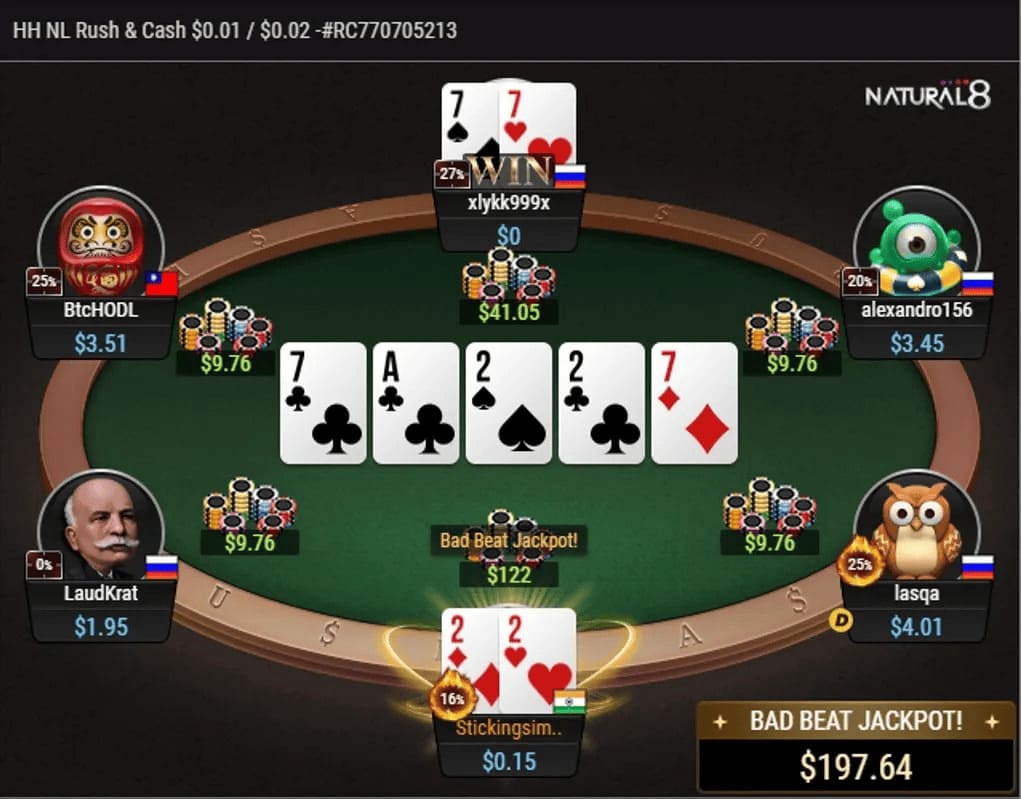 In 2022, Natural8 player "Stickingsimba" experienced exactly the kind of poker nightmare that sounds invented until you see the hand history.
According to PokerNews' report on the Natural8 Bad Beat Jackpot, Stickingsimba was playing $0.01/$0.02 Rush & Cash No-Limit Hold'em with pocket deuces when both players flopped sets. The hand eventually became quads over quads, with all the money going into the middle of the river.
Stickingsimba's quad deuces were beaten by higher quads—a ridiculous bad beat—but there was a consolation prize.
A rather good one.
The losing hand qualified for Natural8's Bad Beat Jackpot, earning Stickingsimba $122 from that hand.
Poker has a strange sense of humour.
How Does Position Change Your Strategy With Quads?
Position gives you more information, but being out of position can sometimes make quads easier to disguise.
When you are in position, you get to see whether your opponent checks before choosing a turn size. Against a player who checks with a range containing plenty of showdown value, betting is usually the obvious route.
Being out of position opens another weapon: the check.
If your opponent is likely to bet after you show weakness, you can check-call or check-raise depending on how their range is constructed.
The mistake is using position mechanically.
Do not think, I'm out of position, therefore I check.
Think, If I check, what does this player do with the hands I want value from?
That produces much better decisions.
How Does Stack Depth Change Turn Strategy With Quads?
Deep stacks make planning more important because you need enough betting streets to move serious money into the pot.
At a low stack-to-pot ratio, the hand almost plays itself.
If the pot is $100 and your opponent has $80 left, getting the remaining chips in by the river should rarely be difficult.
Now imagine the pot is $40 and effective stacks are $800.
Suddenly, checking the turn carries a real cost. One betting street disappears, and getting hundreds of blinds into the middle on the river without looking suspicious becomes nearly impossible.
The deeper you are, the more carefully you should think about pot construction.
Medium and shallow stacks allow more trapping.
Very deep stacks often reward earlier aggression because you need time to build.
Does Tournament Poker Change How You Should Play Quads?
Tournament circumstances can alter sizing and opponent behaviour even though the strength of quads itself does not change.
Near a major pay jump or final-table bubble, players may fold medium strength hands much more readily because survival has additional value.
That can make small bets particularly effective.
At the same time, a player with a full house or another extremely strong hand may still be willing to play a huge pot because their range is powerful enough to overcome that pressure.
Stack distribution also matters.
A short stack with 12 big blinds is much easier to get all-in than a 90-big-blind opponent.
Avoid forcing a cash-game template onto every tournament hand. The cards may be identical, but stack depth, payout pressure, and player incentives are not.
The Biggest Mistakes Players Make After Turning Quads
The biggest quads mistake is assuming such a powerful hand requires no strategy.
It does.
Mistake 1: Automatically Slow Playing
Checking every monster is predictable and often leaves money behind.
Slow play because your opponent is likely to bet—not because poker movies taught you that monsters should look mysterious.
Mistake 2: Betting Too Large Against a Weak Range
Huge bets feel exciting.
They are less exciting when every weak hand folds.
When your opponent has mostly marginal pairs and bluff-catchers, give them a price they can actually pay.
Mistake 3: Betting Too Small Against a Strong Range
The opposite mistake hurts just as much.
If your opponent can have a full house and is unlikely to fold it, stop trying to win an extra six blinds and start thinking about stacks.
Mistake 4: Ignoring the River Before Acting
The river can change more than the winner.
It can complete a draw, counterfeit an opponent's hand, put another scary card on the board, or simply make your turn customer lose interest.
Think ahead.
Mistake 5: Forgetting That Quads Can Lose
It is rare, but higher quads and straight flushes exist.
Read the board before automatically calling an enormous river shove.
Confidence is useful.
Autopilot is not.
A Simple Poker Quads Strategy Checklist
When quads arrive on the turn, run through this mental checklist before touching your chips.
How did I make quads? Pocket pair plus a paired board and one-card quads on a tripled board produce very different opponent ranges.
What can realistically call me? Look for full houses, trips, overpairs, top pairs, draws, and stubborn bluff-catchers.
Will this opponent bet if I check? Aggressive players create trapping opportunities. Passive players usually require you to do the betting.
What is the stack-to-pot ratio? Deeper stacks generally require more deliberate pot building.
Can a river kill my action? A missed draw or frightening community card may reduce future calls even when it does not threaten your hand.
Is there a higher hand possible? Check for higher quads or straight-flush possibilities before playing an enormous river pot.
What river pot am I trying to create? Your turn strategy should set up the final street instead of treating each decision in isolation.
That framework will outperform a rigid rule such as "always slow play quads."
After all, poker rarely rewards the word always.
Final Thoughts: When You Hit Quads, Think About Their Hand Rather Than Yours
The best way to maximize value from quads in poker is to stop staring at your monster and start studying the range across the table.
Four of a kind poker hands are exceptionally powerful. In the standard poker hand rankings, very few holdings can beat them. That means protection becomes a secondary concern and value extraction moves to the front of the queue.
Bet when second-best hands can call.
Check when aggressive opponents can bluff.
Build the pot when deep stacks demand it.
Use smaller sizes when the opponent's range is fragile, and apply more pressure when they can arrive with full houses or other hands too strong to release easily.
Most importantly, plan the turn and river together.
Making quads is luck.
Getting maximum value from them is strategy.
FAQs About Quads in Poker
Should you always slow play quads in poker?
No. Slow playing quads works best when an aggressive opponent is likely to bet after you check or when their range is too weak to call a turn bet. Against passive players or opponents holding many strong second-best hands, betting immediately is often more profitable. Your goal is not simply to disguise the hand; it is to maximize the amount of money that enters the pot.
Can four of a kind lose in Texas Hold'em?
Yes. Four of a kind can lose to a straight flush or to a higher four of a kind. For example, quad sixes beat quad deuces. A higher-quads situation can occur when two players flop different sets and each pocket pair connects with a later community card. These outcomes are extremely unusual, but they are a useful reminder to read the entire board before committing chips.
Is four of a kind better than a full house?
Yes. Under standard poker hand rankings, four of a kind beats a full house. Quads are made from four cards of the same rank plus a fifth card, while a full house combines three cards of one rank with two of another. Only a straight flush—including its highest version, the royal flush—ranks above ordinary four of a kind in traditional high poker.
Should I bet small or large when I turn quads?
Your opponent's range should determine the size. Bet smaller when they hold many weak hands and bluff-catchers that cannot tolerate heavy pressure. Bet larger when their range includes full houses, trips, strong overpairs, or other hands capable of calling significant bets. Stack depth matters too: deeper stacks usually require more pot building if you want to win a large amount by the river.
What is the most important turn strategy when you make quads?
Think one street ahead. Ask what hands your opponent can continue with, whether they are likely to bet when checked to, and what the river could do to their willingness to pay. The strongest turn strategy is rarely about protecting quads. It is about creating the best possible river situation while extracting value from the hands your opponent holds right now.
)
Shane C
Shane is a content writer with over 10 years of writing experience. He specializes in poker and casino games and has been chasing the ultimate poker dream and the excitement of hero calls for the last 15 years! Admittedly, he has yet to win any APT nor WSOP title, but he's not giving up!
)
)
)
)
)
)