
)
- What Kind of Hand Are Pocket Sevens, Really?
- Preflop Strategy: Opening, Calling, and Knowing When to Fold
- Postflop Strategy: Playing Pocket Sevens After the Flop
- Common Mistakes Players Make with Pocket Sevens
- How Stack Depth Changes Your Approach
- Pocket Sevens in Summary: A Cheat Sheet
- Frequently Asked Questions About Pocket Sevens
Pocket sevens is one of those hands that feels exciting when you look down at them — and then immediately makes you nervous. You're holding a pair. That's good. But it's not aces. It's not kings. It's sevens, sitting somewhere in the uncomfortable middle ground of the card universe. And if you don't have a real plan for playing this hand, you'll either bleed chips chasing the wrong spots or fold your way out of pots you could've won.
Here's the thing: pocket sevens aren't a bad hand. Played correctly, 77 is genuinely profitable. Played carelessly, it's a trap you set for yourself.
What Kind of Hand Are Pocket Sevens, Really?
Before we talk strategy, let's get one thing straight. Pocket sevens sit right in what most players call medium pocket pairs — a category that includes roughly 77 through 99. These hands share a common problem: they're strong enough to play, but not strong enough to feel comfortable when the board gets messy.
Your main goal with pocket sevens, most of the time, is simple: flopping a set. That's a seven on the board to give you three-of-a-kind. When that happens, you're often in a dominant position. When it doesn't — which is about 88% of the time — you need a clear plan, because an unimproved pair of sevens on a board full of overcards is a fragile thing.
Preflop Strategy: Opening, Calling, and Knowing When to Fold
Position Changes Everything
Position is the single most important factor in how you play pocket sevens preflop. Full stop.
In early positions — like under the gun or one seat to its left in a full nine or ten-handed game — 77 is a hand you can open-raise for value, but you should do it with some awareness. You're going to get called, and sometimes re-raised, by players who haven't acted yet. When that happens, you're in tough territory.
Against a 3-bet from an early position player, you have a real decision. Calling is usually fine if the effective stack is deep enough — think 50 big blinds or more — because your implied odds justify seeing a flop. If you flop that set, you can win a big pot. But if the stacks are shallow, say 25 big blinds or less, calling a 3-bet with 77 is dicey. You're not deep enough to make set mining work economically.
In middle position and later, pocket sevens play much more comfortably. You have more information about who's already folded, and your post-flop position is often better. Open-raising from middle position or later is standard.
From the small blind, 77 is a hand you raise or fold — not limp. Limping from the small blind with a hand this strong is just giving the big blind a cheap chance to outdraw you.
Facing a Raise: Call and Play or Fold?
If someone raises before you, the question becomes: should you call and play a pot, or let it go?
Generally, call if:
You're getting reasonable odds (not facing a massive 5-bet shove)
The effective stack is deep enough to make set mining worth it
You're in position or close to it
Fold if:
There's a raise and a cold-call in front of you and you're out of position
The shove is too large relative to the pot and stack size
Implied odds are your best friend here. The deeper the stacks, the more you can justify calling — because when you do hit that set, the payoff can be enormous.
Postflop Strategy: Playing Pocket Sevens After the Flop
When You Flop a Set — Maximize Every Dollar
Flopping a set with 77 is genuinely one of the most satisfying moments in poker. You're likely way ahead. Now your job is to get as much money into the pot as possible without scaring your opponent away.
On wet boards — ones with flush draws or straight draws in play — you want to build the pot fast. Slow-playing a set on a dangerous board is how you get outdrawn and then spend the next hour complaining about it. Bet. Get value. Protect your hand.
On dry, uncoordinated boards, you have more flexibility. You can check-call once to let your opponent barrel, then raise on a later street. Or you can bet for value immediately. Read the texture, read the player, and adjust.
The goal in every case: win the pot, and win it big.
When You Miss — Board Texture Awareness
This is where most players lose money with pocket sevens. The flop comes A-K-9. You have two sevens. What now?
On a board like that, your hand is almost certainly behind. The overcards on the board means any opponent holding an ace, king, or even a nine might have you beat. Continuation betting once can be fine, especially if you were the preflop aggressor and the pot is small. But you're not looking to build a huge pot here. You're pot-controlling — keeping things small, taking a cheap showdown if you can.
Pot control is a crucial skill with medium pairs. If your opponent shows serious resistance — a raise, a re-raise — you need to ask yourself honestly: what hand am I beating here? Usually, the answer is "not much." Discipline in these spots saves you a lot of chips over time.
The Middle Position Spot vs. Multiple Opponents
Playing 77 in multiway pots — three or more players seeing the flop — changes the math significantly. Your hand's relative strength drops. Even a pair of sevens on a low board isn't as safe when two or three people are in the pot, because the chances someone has connected with something go way up.
In these spots, lean toward set mining or folding. If you don't flop the set, don't fall in love with an unimproved pair against multiple opponents.
Common Mistakes Players Make with Pocket Sevens
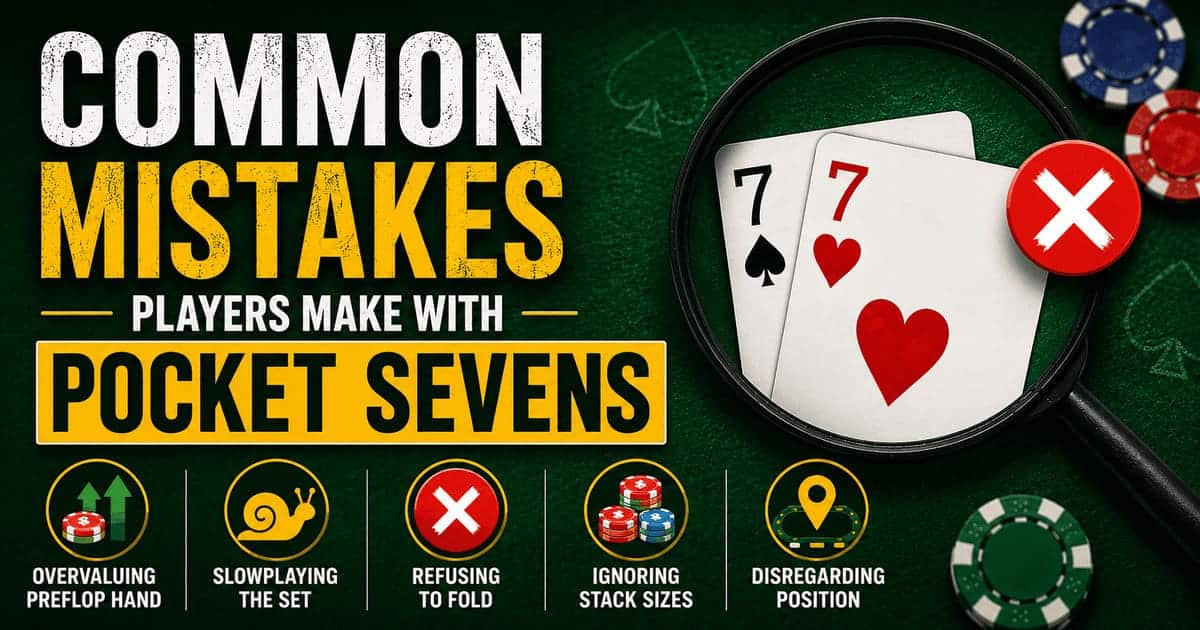
1. Overvaluing the hand preflop. 77 is not a hand to get all-in with preflop in most situations, especially in deep-stacked cash games. It's ahead of a lot of hands, but it's a coin flip against two overcards and a dog against overpairs.
2. Slow-playing the set on wet boards. When the board is draw-heavy, you need to charge people for their draws. Don't get cute.
3. Refusing to fold on scary boards. If you miss and the board is full of overcards, continuing to barrel off chips hoping your opponent is bluffing is a costly habit.
4. Ignoring stack sizes. The decision to call and play or fold preflop is heavily tied to the stack sizes in play. Deep stacks? Call more. Short stacks? Be more selective.
5. Playing the same way from every position. As we covered — position matters enormously. Don't treat early position the same as late position.
How Stack Depth Changes Your Approach
This deserves its own moment. Stack sizes are arguably the most underappreciated element when playing pocket sevens.
With 100+ big blinds effective, implied odds are at their peak. You can call raises, see flops, and potentially win massive pots when you connect. The deeper the money, the more valuable set mining becomes.
With 20–35 big blinds, you're often better off just shoving or folding preflop, particularly if you're facing a raise. Set mining at that depth doesn't have the right economics. You won't win enough when you hit to justify the times you miss.
At medium stack depths — say 40–70 big blind range — it's situational. Position, opponent tendencies, and the size of the raise all matter. Think it through each time rather than going on autopilot.
Pocket Sevens in Summary: A Cheat Sheet
Deep stacks + position: Call and play, aim to set mine
Short stacks: Look for spots to shove or fold — don't call off and miss
Hit the set: Build the pot aggressively, especially on wet boards
Miss the set: Keep the pot small, be ready to fold to big resistance
Early positions: Open-raise is fine, but respect 3-bets
Multiway pots: Proceed with caution unless you've hit the set
Frequently Asked Questions About Pocket Sevens
Should I always raise with pocket sevens preflop?
In most situations, yes. Limping in with 77 gives the table a cheap look at a flop that might crack your pair. A standard raise builds a pot when you have the best hand and gives you the option to take it down before the flop too. The exception is when you're facing a massive raise from an early position player — then it becomes a call-or-fold decision based on stack depth.
What is set mining, and how does it apply to pocket sevens?
Set mining is when you call a preflop raise primarily hoping to flop three-of-a-kind (a set). With pocket sevens, this is your most reliable path to a big pot. The math works best with deep effective stacks — at least 15–20 times the amount you're calling — so that the potential winnings justify the times you miss the set, which is roughly 88% of flops.
Is it worth 3-betting with pocket sevens?
Sometimes. Against loose or aggressive players who open wide, a 3-bet with 77 can take the pot down immediately or make you the aggressor going to the flop. Against tight early-position raisers, flatting is usually better. Context matters more than a blanket rule here.
How do I handle pocket sevens against a 4-bet shove?
In most situations, you fold. A 4-bet shove from a tight player almost always represents aces, kings, queens, or ace-king. You're either in a flip or a serious underdog. Save your chips for a better spot. If you're playing against a known maniac, the math changes, but that's the exception.
What's the best board texture to see with pocket sevens?
Low, dry, rainbow boards are your best friend — something like 2-5-9 with no flush draws. It's unlikely your opponent connected, and your pair still has strong equity. Wet boards with high cards are the worst — they give your opponents both the overcards and drawing equity you don't want to fade.
Can I slow-play a set of sevens?
You can, but you need to pick your spots carefully. On a dry board with no realistic draws, slow-playing once to let your opponent catch up or bluff can be profitable. On any board with flush draws, straight draws, or paired cards, slowing down risks letting free cards that beat you. When in doubt, bet.
How does position affect playing pocket sevens postflop?
Dramatically. Being in position means you get to see how your opponent acts before you decide. If they check, you can bet or take a free card. If they bet, you have information before putting chips in. Out of position, you're guessing more and giving your opponent the advantage of reacting to you.
Should I be worried about overcards on the flop when I have pocket sevens?
Yes, and you should factor it into your plan. Any ace, king, queen, jack, or ten on the flop is an overcard to your sevens. One overcard? You might still be ahead. Two or three? Proceed with serious caution. The more overcards on the board, the more likely you're already behind, and the more important pot control becomes.
)
Shane C
Shane is a content writer with over 10 years of writing experience. He specializes in poker and casino games and has been chasing the ultimate poker dream and the excitement of hero calls for the last 15 years! Admittedly, he has yet to win any APT nor WSOP title, but he's not giving up!
)
)
)
)
)
)
)