- What Is the Best Poker Chip Distribution for a Home Game?
- Poker Chip Distribution Chart for 2–10 Players
- How Do You Choose the Right Poker Chip Starting Stack?
- How Should You Distribute Poker Chips for Cash Games?
- What Values Should Different Poker Chip Colors Represent?
- Is a 500-Chip Set Enough for a Home Poker Game?
- When Should Blinds Increase, and How Do You Color Up Chips?
- How Can You Prepare Your Poker Chips Before Guests Arrive?
- Frequently Asked Questions
Nothing slows down a poker night faster than constantly stopping to make change. One player has too many small chips, another only has large ones, and suddenly everyone is waiting instead of playing.
A good poker chip distribution helps prevent these problems before the first hand is dealt. Whether you're hosting a casual Texas Hold'em tournament or a friendly cash game, the goal is simple: give everyone a manageable starting stack with enough smaller chips to keep the action moving.
Here's how to get it right.
What Is the Best Poker Chip Distribution for a Home Game?
For a simple home poker tournament, around 20–35 physical chips per player can be a practical starting point. The ideal number depends on your starting stack, blind structure, and available denominations.
One workable option is a starting stack worth 5,000 in tournament chips, divided as follows:
12 × 25-value chips = 300
12 × 100-value chips = 1,200
7 × 500-value chips = 3,500
Total: 31 physical chips with a combined tournament value of 5,000 per player.
With opening blinds of 25/50, everyone begins with 100 big blinds. This gives players room to make decisions before the blinds increase, although the tournament's pace also depends on the length and progression of your blind levels.
Poker Chip Distribution Chart for 2–10 Players
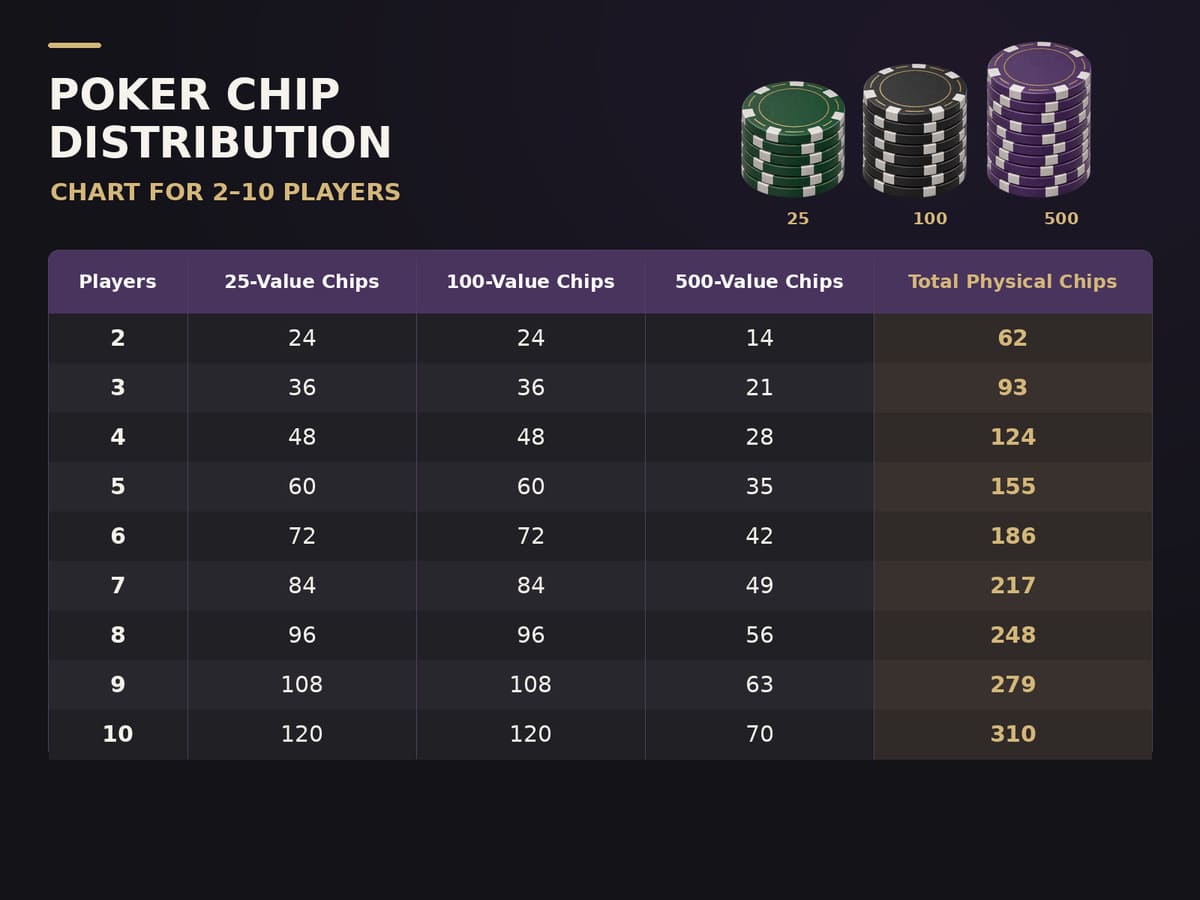
For a standard home tournament, give everyone the same starting stack value.
The table below shows how many chips you'll need to prepare a 5,000-chip starting stack for each player. These figures cover starting stacks only; keep additional chips available for rebuys and color-ups.
| Player | 25-Value Chips | 100-Value Chips | 500-Value Chips | Total Physical Chips |
|---|---|---|---|---|
| 2 | 24 | 24 | 14 | 62 |
| 3 | 36 | 36 | 21 | 93 |
| 4 | 48 | 48 | 28 | 124 |
| 5 | 60 | 60 | 35 | 155 |
| 6 | 72 | 72 | 42 | 186 |
| 7 | 84 | 84 | 49 | 217 |
| 8 | 96 | 96 | 56 | 248 |
| 9 | 108 | 108 | 63 | 279 |
| 10 | 120 | 120 | 70 | 310 |
Each player receives 12 × 25, 12 × 100, and 7 × 500, totaling 5,000 in tournament value.
The starting stack stays the same regardless of player count. Only the total number of physical chips required changes.
For example, an eight-player tournament needs 248 chips for its starting stacks, while a ten-player game needs 310.
How Do You Choose the Right Poker Chip Starting Stack?
Start with your blinds, not just the number of chips in your case. The relationship between the starting stack and the big blind determines how deep players begin.
For example, a 5,000 starting stack with 25/50 blinds equals 100 big blinds. Change the opening blinds to 50/100, and that same stack becomes 50 big blinds.
Here are three things worth remembering:
Include enough small denominations. Players need them to post blinds and make bets without repeatedly exchanging chips.
Choose a manageable mix. More physical chips are not automatically better or worse. Give players enough for convenient betting without unnecessarily filling their stacks with small denominations.
Keep chips in reserve. Higher-denomination chips are useful for rebuys and replacing smaller chips later. Spare smaller denominations can also help with making change.
A balanced starting stack makes managing the game easier for everyone.
How Should You Distribute Poker Chips for Cash Games?
Cash-game chips have agreed monetary values and can be exchanged for money when a player cashes out. Tournament chips represent a player's tournament stack and are not redeemable at their face value.
Suppose you're hosting a 0.25/0.50 Texas Hold'em cash game with a $50 buy-in.
Here's a straightforward distribution:
| Chip Value | Quantity | Total Value |
|---|---|---|
| $0.25 | 12 | $3 |
| $1 | 12 | $12 |
| $5 | 7 | $35 |
| Total | 31 Chips | $5 |
Each player begins with 100 big blinds and a mix of denominations for posting blinds and making bets.
For eight players buying in for $50 each, you'll need 248 physical chips representing $400 in total buy-ins.
Keep additional chips in the bank for further buy-ins, top-ups, and change. Record all money received and cash-outs paid. Assuming no fees or other deductions, the value of chips still in circulation should equal total buy-ins and top-ups minus completed cash-outs.
Unused chips in the bank do not count as chips in circulation.
What Values Should Different Poker Chip Colors Represent?
Chip color is a convenient way to identify value, but home games don't have to follow casino conventions.
For cash games, familiar US-style denominations include:
| Chip Color | Common Value |
|---|---|
| White | $1 |
| Red | $5 |
| Green | $25 |
| Black | $100 |
These are common conventions, not universal rules. Values can vary between venues and regions. Lower-stakes home games also need smaller denominations, such as $0.25, whose color can vary.
Tournament chip sets are flexible too. You can assign distinct colors to values of 25, 100, 500, and 1,000.
If your chips have printed denominations, use those values to avoid confusion. For unmarked chips, display a simple color-value chart and keep the assigned values consistent throughout the game.
Is a 500-Chip Set Enough for a Home Poker Game?
A 500-chip set is generally enough for a single-table game with eight to ten players, provided it has the right denomination mix and enough reserve value.
Using our suggested ten-player tournament distribution, you'll need 310 physical chips for the starting stacks, leaving 190 chips in the case.
There's one catch, though.
Not every 500-chip set contains the same number of each color. If your starting stacks require 120 chips worth 25 each, but your set only contains 50 of that denomination, you'll need to adjust your distribution.
The remaining chips must also be useful for your game. Having 190 spare chips does not automatically mean you have enough value for every planned rebuy or the right denominations for later color-ups.
Count the chips by denomination and plan your reserves before your guests arrive.
When Should Blinds Increase, and How Do You Color Up Chips?
As tournament blind levels increase, smaller chips gradually become less useful. Exchanging them for higher denominations and removing them from play is known as coloring up.
For a casual home tournament, one possible opening sequence is 25/50, 50/100, 75/150, and 100/200, with levels lasting around 20–30 minutes. These are suggested house settings, not fixed rules. Prepare the rest of the schedule before play begins.
Only remove a denomination when the remaining blind and ante schedule no longer requires it. For example, if you plan to use a 150/300 level, keep the 25-value chips available to make the 150 small blind.
When coloring up, exchange complete multiples at equal value. For instance, four 25-value chips become one 100-value chip.
Leftover chips need a separate procedure. A player with five 25-value chips holds 125, which cannot be exchanged exactly using only denominations of 100 or higher.
Formal tournaments commonly use a chip race to handle these leftovers. Under Poker TDA rules, a player can receive at most one chip from the race and cannot be eliminated by losing their last chips in it. A casual home game can instead use a clearly announced house rule, such as rounding each player's leftover amount up to the next remaining denomination.
Either approach may change individual chip totals slightly. Explain the method before play begins and apply it consistently.
How Can You Prepare Your Poker Chips Before Guests Arrive?
A few minutes of preparation can make the whole evening run more smoothly.
Decide whether you're playing a tournament or cash game, confirm the number of players, and choose your chip values. Then arrange identical starting stacks for tournament players, grouping chips by denomination so they're easy to count.
Keep reserve chips separate and display the chip values somewhere visible. For tournaments, prepare the full blind schedule and decide when and how you'll color up. For cash games, have a simple record ready for buy-ins, top-ups, and cash-outs.
Once everyone sits down, you can focus on the poker rather than the mathematics.
Frequently Asked Questions
1. Can I Give Every Player 50 Poker Chips?
Yes. Fifty physical chips per player can work if the denomination mix suits your game. There is no fixed ideal chip count.
The example in this guide uses 31 chips per player, which provides a manageable 5,000 starting stack. Giving ten players 50 chips each would use an entire 500-chip set, leaving no unused chips in reserve at the start.
Focus on stack value, convenient denominations, and reserve requirements rather than chip count alone.
2. What If My Poker Chip Set Only Has Three Colors?
Three colors are enough for a simple home tournament. For example, you could assign values of 25, 100, and 500 and use the 5,000-chip distribution shown earlier, provided you have enough chips of each color.
Reserve some 100- and 500-value chips if you plan to remove smaller denominations later. An additional higher denomination can make late-stage stacks easier to manage, but it is not essential.
Keep each color's value fixed throughout play.
3. How Do Rebuys Affect Poker Chip Distribution?
Rebuys require additional chip value, but not necessarily another full set of small chips. For a tournament, you can issue higher-denomination chips worth the agreed rebuy stack and make equal-value exchanges for smaller chips when necessary.
Plan for the number and value of rebuys you intend to allow, and keep enough chips in reserve.
In a cash game, record each additional buy-in or top-up so the money held in the bank continues to match the value of chips in circulation.
4. How Can I Check Whether My Cash Game Chips Balance Correctly?
Add together the value of every chip in circulation, then compare that figure with:
Total buy-ins and top-ups − cash-outs already paid
For example, eight players buying in for $50 each creates $400 in chips. If two players later buy another $50 each, the total becomes $500, assuming no cash-outs.
If a player then cashes out $80 and returns their chips to the bank, the remaining chips in circulation should represent $420. The bank should also hold $420, assuming no fees or other deductions.
Keeping a simple record helps prevent errors when the remaining players cash out.

Shane C
Shane is a content writer with over 10 years of writing experience. He specializes in poker and casino games and has been chasing the ultimate poker dream and the excitement of hero calls for the last 15 years! Admittedly, he has yet to win any APT nor WSOP title, but he's not giving up!