
)
Online poker has grown into something enormous. In 2026, over 70% of all poker traffic happens on mobile devices alone — and the industry is on track to be worth tens of billions of dollars before the decade is out. Millions of players log on every single day, from micro-stakes grinders to high-rollers chasing six-figure prize pools.
But here's the honest truth nobody says upfront: online poker isn't for everyone. It's a fundamentally different experience from sitting at a live table, and those differences matter far more than most people expect.
So before you deposit anywhere, let's break it all down. The real pros, the real cons, and everything in between — updated for where the game actually stands right now.
What Is Online Poker, Really?
At its core, online poker is the same card game you'd play in any poker room — Texas Hold'em, Omaha, Seven-Card Stud. The rules haven't changed. What has changed, dramatically, is the environment.
You're no longer reading faces or listening to how someone breathes. You're staring at a screen, clicking buttons, and making decisions in seconds — often on your phone, in your living room, at midnight. That shift from a live game to an online game is bigger than it sounds. It changes your strategy, your psychology, and honestly, your whole relationship with the game.
The Pros of Online Poker
1. The Ability to Play Anytime, from Anywhere
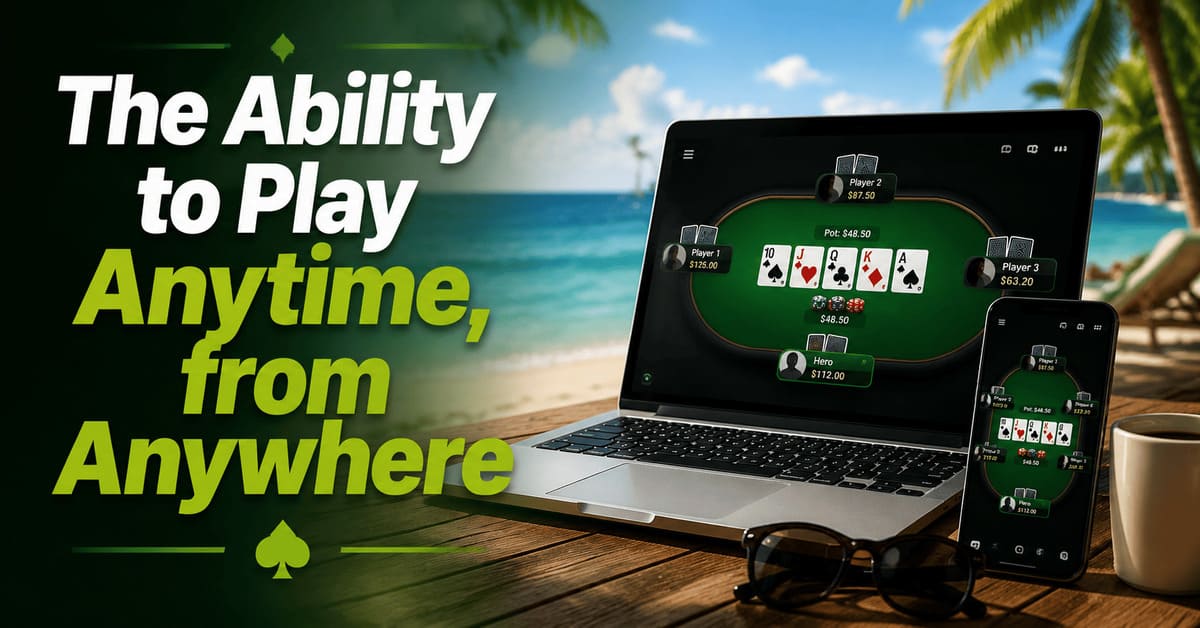 This is the big one. No dress code, no drive, no waiting for a seat. Whether it's 2 p.m. or 2 a.m., online poker games are running somewhere in the world. For new poker players especially, this accessibility is genuinely game-changing. You're not walking into a poker room full of regulars who've been playing together for years. You log in, pick a table, and start.
Mobile has made this even more radical in 2026. The best platforms now offer fully optimised apps where you can play a full session one-handed. The barrier to entry has never been lower.
2. You Can Play Multiple Tables at Once
This is something live poker simply cannot offer. Online, an experienced poker player can run four, six, even ten tables simultaneously. More hands per hour. More decisions. More data. More opportunities.
Multi-tabling isn't easy — it demands real discipline — but it's one of the most powerful financial advantages of online play. If you're a winning player, even at a small edge, multiplying that edge across multiple tables turns modest profit into serious volume.
3. Stakes Are Incredibly Flexible
Online poker rooms offer micro-stakes games that simply don't exist in most live poker environments. You can play for pennies. Literally. That kind of entry point is invaluable for new poker players who want to learn the game without burning through their bankroll.
At the other end, high stakes games online can match or exceed the biggest live game action anywhere in the world. In 2026, fast-fold formats like Zoom and Snap poker have added a whole new dimension for players who want maximum volume at any stake level.
4. Bonuses and Promotions Add Real, Tangible Value
One undeniable upside of online poker vs live poker: the bonuses. Welcome offers, reload bonuses, rakeback deals, leaderboards, jackpots, freerolls. These don't exist when you sit down at a casino card table.
Over time, a smart poker player who understands how to extract value from promotions can meaningfully reduce the cost of playing — or add directly to their winnings. On the right platform, rakeback and promotions alone can flip a break-even player into a profitable one.
5. It's Faster — Much Faster
A live game deals maybe 25–30 hands per hour. Online? Easily 60–80. Add multi-tabling and you're seeing hundreds of hands per hour. That speed means you accumulate experience far faster. Variance evens out sooner. You don't have to sit through a slow, social night at the poker room to get meaningful sample sizes.
For anyone serious about improving, online play compresses years of learning into months.
6. Built-In Study Tools Are Now Standard
This is a genuine 2026 upgrade worth noting. The best online platforms now ship with integrated hand history exports, built-in analytics, and performance dashboards — no third-party software needed. You can review your session the moment it ends, identify leaks, and study directly within the app. That kind of structured feedback loop simply doesn't exist in live poker.
The Cons of Online Poker
1. The Competition Is Tougher Than You Think
Here's something that genuinely surprises a lot of new players: online poker, even at the lower stakes, can be brutally competitive. You're playing against grinders from around the world — people who study the game intensely, have logged thousands of hours, and know exactly what they're doing.
In 2026, the skill gap has widened further. Solver tools have become standard study aids. Recreational pools have shrunk while the density of regulars has grown. In a local poker room, you might sit across from casual Friday-night players. Online, even micro-stakes tables attract serious grinders. Don't underestimate that shift.
2. You Lose the Social Experience
Live poker has something online poker can never fully replicate: the atmosphere. The table talk, the tells, the shared energy when someone makes a wild bluff or a terrible call. Online play strips most of that away.
For some players — especially those who love the social side of card games — that's a dealbreaker. Sitting alone at a computer clicking buttons lacks the human connection that makes live poker so compelling. Some platforms have tried to bridge this gap with features like live video reactions at the table, but it's still not the same as being physically present.
3. You Need a Reliable Internet Connection
This sounds minor until it isn't. A dropped internet connection mid-hand can cost you a pot. Technical glitches and disconnections are real risks that don't exist in a live game. Most platforms have disconnect protection, but it's not foolproof — and it adds a layer of uncertainty that live players never deal with.
4. Online Poker Is Easier to Play Badly — and Too Often
The speed and convenience of online play can genuinely work against you. It's easy to play when you're tired, frustrated, or tilting. In a live game, there are natural brakes — the drive home, the time between hands, the physical effort of being there. Online, the next session is one click away at any hour.
That ease can lead to poor decisions, chasing losses, and playing far more than you should. Any honest online poker review will tell you the same thing. Self-discipline is not optional here — it's essential infrastructure.
5. Reduced Ability to Read Opponents
In live poker, you're watching everything — posture, timing, eye contact, betting patterns. You build a full picture of every player at the table across every hand. Online, you lose most of that. You have timing tells and bet sizing patterns, but the richness of live reads isn't available.
For players who've built their game on reading people, the adjustment is significant. Online poker rewards a more mathematically rigorous, data-driven style. If your game runs on instinct and social intelligence, expect to rebuild parts of it from scratch.
6. Legality and Platform Trust Vary by Region
Not every country allows online poker. And even where it's legal, not every site is trustworthy. Choosing a licensed, regulated platform is non-negotiable — but navigating that adds complexity that doesn't exist when you walk into a properly licensed poker room.
Always verify that any platform holds a legitimate gaming licence before depositing. Read real, independent online poker reviews first.
Online Poker vs Live Poker: Which Is Better for You?
Honestly? Neither is universally "better" — they suit different players and different goals.
Live poker rewards social intelligence, patience, and reading people. It's slower, more atmospheric, and often more enjoyable for casual players who treat the game as a night out. The fields at lower stakes live games are still genuinely soft in many areas in 2026 — experienced live players can find real edges there.
Online poker rewards discipline, mathematical precision, and volume. It's efficient, flexible, and far more accessible for players who want to improve quickly or play regularly without the logistics of visiting a poker room.
Many serious poker players do both. They use online play to sharpen technical skills and accumulate volume, then bring that refined game to live tables where recreational players are more plentiful. That combination is arguably the smartest approach in 2026.
Is Online Poker Worth It in 2026?
For a casual player who wants entertainment and flexibility — yes, absolutely. The platforms are better than ever, the game variety is enormous, and the ability to play at any stake from any device makes online poker more accessible than it's ever been.
For someone asking "is online poker worth it" from a profit standpoint — the honest answer is: it's harder than it used to be, but the opportunity is still real for players willing to study and be selective. Game selection matters more now. So does choosing a platform where recreational players are actively part of the ecosystem rather than being driven away by a sea of regulars.
Ready to Play? Here's Where We'd Start
If you're ready to give online poker a proper shot, platform choice matters more than most beginners realise. Not all poker rooms are built the same — and in 2026, Natural8 consistently stands out as one of the best choices for players based in Asia.
Here's why it makes sense, honestly and practically:
The player pool is massive. Natural8 runs on the GGPoker Network — one of the largest poker networks in the world, with over 100,000 players online at peak times. That means action at every stake level, 24/7, without waiting for a table.
The games are genuinely soft. Natural8 has a well-deserved reputation for attracting recreational players. The platform is designed for casual enjoyment first, which keeps the player pool fresher than on more grinder-heavy networks. For new poker players, that matters a lot.
Third party HUDs and trackers are banned. This is a deliberate design choice that levels the playing field. Regulars can't exploit you with third-party tracking software, which makes the environment fairer — and more enjoyable — especially for those just finding their feet online.
The features are genuinely useful. Built-in tools like PokerCraft (hand history analytics), EV Insurance, Run It Twice, and Smart HUD give you professional-grade tools without needing to install anything extra. You can study your game immediately after a session, right inside the app.
Promotions are stacked. Welcome bonuses, daily leaderboards, the Newcomer 30-Day Challenge, weekly freerolls, and WSOP qualifier satellites give you consistent extra value as both a new and returning player.
Natural8 isn't perfect — rake is on the higher end, and it isn't available in all regions (US and UK players can't currently access it). But for players in Asia, it's one of the most complete online poker experiences available right now.
Pros and Cons: Quick Summary
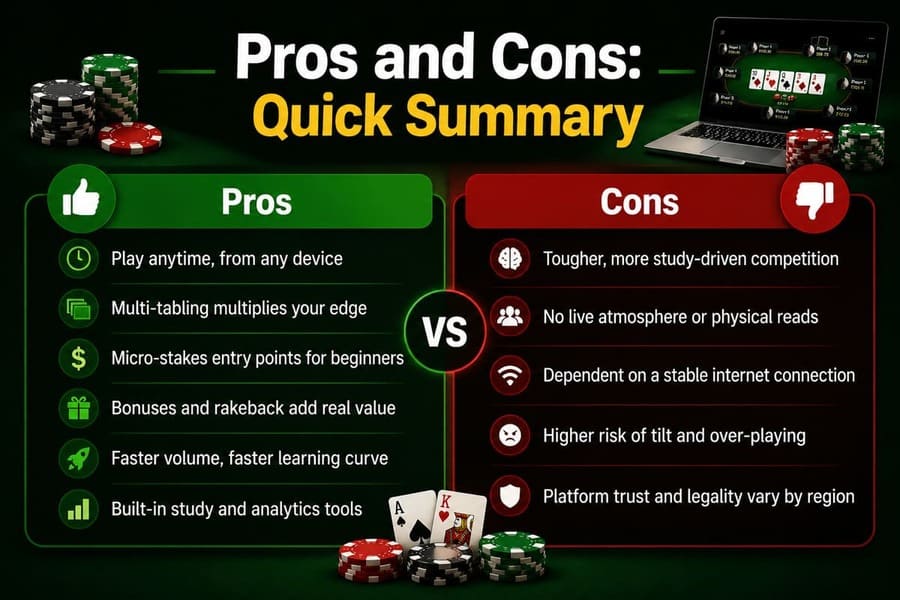
Pros:
Play anytime, from any device
Multi-tabling multiplies your edge
Micro-stakes entry points for beginners
Bonuses and rakeback add real value
Faster volume, faster learning curve
Built-in study and analytics tools
Cons:
Tougher, more study-driven competition
No live atmosphere or physical reads
Dependent on a stable internet connection
Higher risk of tilt and over-playing
Platform trust and legality vary by region
Frequently Asked Questions
Is online poker harder than live poker in 2026?
Generally yes, especially at comparable stakes. Online poker attracts a high density of technically strong players, even at low levels. In 2026, solver tools and built-in analytics have raised the average skill floor further. That said, live poker has its own challenges — social pressure, emotional exposure, and slower feedback loops. Many players find both formats demanding in different ways, just for different reasons.
Can you actually make money playing online poker?
Yes, but it's genuinely difficult. Most recreational players lose over time, while a smaller percentage of disciplined, skilled players profit consistently. Success online requires solid fundamentals, strict bankroll management, off-table study, and the mental resilience to handle variance. Treating it as entertainment first — with profit as a longer-term goal — is probably the healthiest and most realistic starting mindset.
What's the best way for beginners to start playing online poker?
Start at the lowest stakes available — usually $0.01/$0.02 or play-money tables. Focus on one format; most beginners do well starting with Texas Hold'em cash games. Watch training content, review your hands after each session, and avoid jumping stakes before your bankroll and skills genuinely support it. Platforms like Natural8 have beginner-friendly programmes specifically designed to ease new players in without overwhelming them.
How does multi-tabling affect your game quality?
Multi-tabling increases hands per hour but demands more systematic, less creative decision-making. It suits technically solid players who've internalised their fundamentals. Beginners who multi-table too early often develop lazy habits and miss important learning opportunities. Start with one table. Add a second only when the first feels genuinely comfortable and automatic. Volume only helps if decision quality holds up across every table you're running.
Is Natural8 safe and legit to play on?
Yes. Natural8 is a licensed, regulated online poker room operating under the GGPoker Network — one of the world's largest and most reputable poker networks. It has been running since 2016 and has an established track record for reliable payouts and fair gameplay. The platform bans HUDs and tracking software, which also protects players from the data-exploitation practices found on less regulated sites.
Why do experienced live poker players sometimes struggle when they move online?
Live poker players often rely heavily on physical reads, table dynamics, and social cues — none of which translate directly to the online game. The faster pace and anonymity of online play can feel disorienting at first. Without opponents' body language to anchor decisions, some players feel adrift. The adjustment requires leaning harder on fundamentals: position, bet sizing patterns, pot odds, and range thinking — skills that live players may have underweighted in their overall game.
This article is for informational purposes only. Please gamble responsibly. If gambling is causing you concern, contact a recognised responsible gambling organisation in your region.
)
Shane C
Shane is a content writer with over 10 years of writing experience. He specializes in poker and casino games and has been chasing the ultimate poker dream and the excitement of hero calls for the last 15 years! Admittedly, he has yet to win any APT nor WSOP title, but he's not giving up!
)
)
)
)
)
)
)