
)
- What is the Hijack Position in Poker?
- The Strategic Geometry: Bridging the Gap at the Poker Table
- Hijack Poker Opening Ranges: When to Strike
- How Do You Play the Hijack Position Effectively?
- How to Defend the Hijack Against a 3-Bet?
- Navigating Post-Flop Play from the Hijack
- Why Acting Last is King:
- Adjusting Your Strategy: Home Games vs. Professional Apps
- Common Mistakes to Avoid in the Hijack
- To Conclude
- Frequently Asked Questions
Alright, let's dive into one of my favorite spots at the table. If you've spent any time grinding on a poker app or sitting under the bright lights of a room like the Texas Card House, you know that where you sit often matters more than what you’re holding.
We’re talking about the hijack poker seat—the position that feels like a secret weapon when you know how to wield it.
What is the Hijack Position in Poker?
The hijack in poker is the seat located two positions to the right of the dealer button, acting as the transition between middle and late position.
Why is it called the hijack? Because your goal is to "hijack" the natural advantage of the cutoff and button. By being the first to decide to raise, you effectively seize control of the pot, often forcing the late-position players to fold and giving you the "on-the-button" advantage for the rest of the hand. It is the ultimate bridge between the cautious middle positions and the aggressive late positions.
The Strategic Geometry: Bridging the Gap at the Poker Table
When you’re the hijack, you are in a unique tactical limbo. You aren't quite in the "danger zone" of the early positions, where you have to worry about eight people acting after you, but you aren't yet in the total freedom of the Button.
Strategic depth in this seat comes from the realization that you can play more aggressively than those who acted before you. Since there are fewer players acting behind you, the mathematical probability of someone waking up with a monster hand like Pocket Aces or Kings decreases significantly. This shift in frequency allows you to open up your game, moving away from "nit" behavior and toward a more dominant, pro-active style.
Hijack Poker Opening Ranges: When to Strike
If you want to dominate the poker table, you can't just play any two cards. However, the Hijack is where we start to see a wider range than what we’d see from Under the Gun (UTG).
What Hands Should You Open?
A solid Hijack opening range usually consists of about 20% to 23% of all possible hands. This includes:
All Pocket Pairs: From 22 up to AA.
Strong Broadways: Hands like AK, AQ, AJ, and KQ.
Suited Connectors: JTs, 98s, and even 76s if the table is playing passively.
Suited Aces: Most suited Aces play well here because they provide "nut" potential.
Hijack Poker Opening Range Cheat Sheet
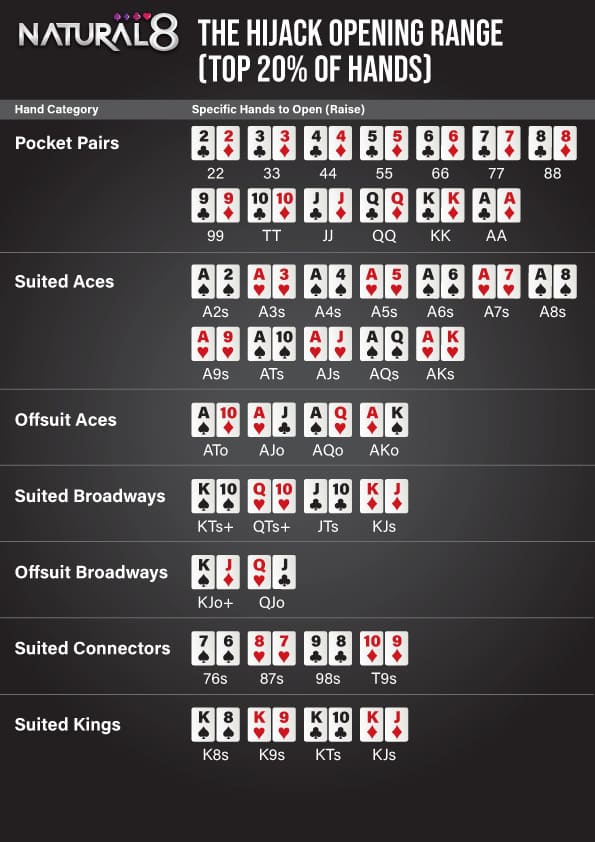 When you play a wider range of hands, you keep your opponents guessing. If you only raise the top 5% of hands, even a novice player will know to fold when you enter the pot. By mixing in those suited connectors, you become a nightmare to read.
How Do You Play the Hijack Position Effectively?
Stealing the blinds is the bread and butter of a professional's win rate. From the Hijack, you have a prime opportunity to "lighten" your requirements if the players in the Cutoff and Button are playing too tight.
Think of it this way: if the guy on the Button is nursing a short stack or playing very conservatively, you essentially become the Button. By raising, you put immense pressure on the small blind and big blind. Most of the time, they will miss the flop, and a simple continuation bet (C-bet) will take down the pot. It’s free money, and in Texas Hold'em, those small wins add up to a massive stack over time.
How to Defend the Hijack Against a 3-Bet?
Defending isn't just about stubbornly calling; it's about understanding frequency and "four-betting" as a tool for deterrence. If you fold every time the Button sneezes, you’re basically giving them a license to steal your chips.
The 4-Bet Bluff: Use hands like A-5 suited or K-Q suited to re-raise (4-bet). These hands have "blockers"—meaning it’s statistically less likely your opponent has AA or KK.
The "Call and Evaluate" Range: Medium pocket pairs (77-JJ) and strong suited connectors (JTs, QJs) are excellent for calling 3-bets. You’re looking to flop a set or a massive draw to crack their high-card hands.
Knowing When to Fold: If a very tight player 3-bets you from the big blind, they likely aren't "stealing the blinds." In these spots, it's perfectly okay to muck hands like KJ offsuit or small pairs.
By mastering these defensive nuances, you ensure that the term hijack stays true to its name—you’re the one in control, even when the table tries to fight back.
Navigating Post-Flop Play from the Hijack
Position is the "cheat code" of poker. When you raise from the Hijack and get called by a player in the early positions, you have the massive advantage of acting last on every subsequent betting round.
Why Acting Last is King:

Information Gathering: You see what your opponent does before you have to put a single chip in the pot.
Pot Control: You decide if the pot stays small or gets big.
Bluffing Efficiency: It is much easier to represent a strong hand when your opponent has already shown weakness by checking.
However, be careful if the Cutoff or Button calls you. In that scenario, you'll be playing "out of position," which is much trickier. In these spots, you need to tighten up and play a more "check-heavy" strategy to protect your range.
Adjusting Your Strategy: Home Games vs. Professional Apps
Playing poker at your local casino is vastly different from playing on a poker app. In live games, players tend to call too much, meaning your "steals" won't work as often. You should prioritize "linear" ranges—hands that have high raw equity.
Online, where players are more aggressive and understand poker terms and 3-betting frequencies, you need to be prepared to fold your weaker raises to a re-raise. Don't fall in love with a hand like K-T offsuit just because you're in the Hijack. If the Button 3-bets you, it’s often a one-way ticket to the muck.
Common Mistakes to Avoid in the Hijack
Even seasoned pros can stumble in this transitional seat. The most frequent error? Over-valuing "pretty" hands. Just because a J9 suited looks good doesn't mean it’s an automatic raise if there’s a massive "whale" or an aggressive "reg" sitting behind you.
Another mistake is ignoring the stack sizes of the small blind and big blind. If the blinds are very short-stacked, they are more likely to shove all-in over your raise. In that case, you should tighten your range and only raise hands that can comfortably call a shove.
To Conclude
Mastering the hijack position in poker is ultimately about transforming a positional "in-between" into a relentless profit engine. While the early positions force you into a defensive shell and the button offers total freedom, the hijack is where the real tactical artistry happens—it's the spot where you decide whether to play it safe or seize the table’s momentum.
By tightening your ranges against aggressive opponents and expanding them to exploit passive blinds, you effectively dictate the flow of the game before the "true" late positions even get a chance to breathe.
Don't just sit there waiting for Aces; start treating the hijack like the strategic bridge it is, and you'll find yourself vacuuming up pots that your opponents are too timid to contest.
Frequently Asked Questions

What does the hijack mean in poker?
The term hijack refers to the seat two spots to the right of the dealer button. It is positioned between the middle position and the cutoff. The name comes from the player’s ability to "hijack" the pot-stealing opportunities that usually belong to the players in late positions, effectively taking control of the hand before the button has a chance to act.
Is the hijack considered a middle or late position?
The hijack is technically the final seat of the middle positions, but it is often played with a late-position mindset. It serves as a tactical bridge. While you must still be wary of the players behind you, the reduced number of opponents remaining allows you to adopt a more aggressive, "wider" opening range than you would from the early seats.
How should I adjust my hijack range in a tournament?
In tournaments, your hijack strategy should shift based on "bubble" pressure and stack sizes. If you have a large stack, you can use the hijack to bully middle-stacks who are trying to fold their way into the money. However, if there are short stacks behind you, you should avoid raising "fold-to-3-bet" hands, as they are likely to shove over the top.
Should I ever limp from the hijack?
Generally, no. In modern Texas Hold'em, "limping" (just calling the big blind) is considered a weak play that gives the blinds a free look at the flop. From the hijack, you should either decide to raise to take control or fold. Raising allows you to win the pot immediately if everyone folds, which is a result you lose by just limping.
What is the difference between the hijack and the cutoff?
The hijack sits directly to the right of the cutoff. While both are advantageous, the cutoff is objectively better because there is one fewer player left to act. In the hijack, you have to worry about the cutoff, the button, and both blinds. In the cutoff, you only have to worry about the button and the blinds, allowing for an even wider range.
Why is the hijack a good position for stealing the blinds?
It's all about the "narrowing field." By the time the action reaches the hijack, several players have usually folded. This increases the likelihood that the remaining players—the cutoff, button, and blinds—don't have premium cards. A well-timed raise can often "clear the field," allowing you to take down the small blind and big blind without even seeing a flop.
)
Shane C
Shane is a content writer with over 10 years of writing experience. He specializes in poker and casino games and has been chasing the ultimate poker dream and the excitement of hero calls for the last 15 years! Admittedly, he has yet to win any APT nor WSOP title, but he's not giving up!
)
)
)
)
)
)
)