- Why Is the Previous Poker Tournament Buy-In a Sunk Cost?
- What Should You Check Before Re-Entering a Poker Tournament?
- When Does the Re-Entry Checklist Say Yes or No?
- Are Re-Entries the Same as Rebuys?
- The Bottom Line: Would You Buy This Entry Fresh?
- Frequently Asked Questions About Poker Tournament Re-Entries
You’ve just been eliminated. Maybe your aces got cracked. Maybe you made a call you already regret. Either way, the re-entry button is still there. It looks like a second chance. But it is also another purchase.
Should you re-enter a poker tournament? Only if you would enter the event now, the cost fits your budget, the stack is playable, and you are not chasing losses. The previous entry alone is never a reason to buy another.
Why Is the Previous Poker Tournament Buy-In a Sunk Cost?
The chips are gone, and another entry will not bring them back. Your first poker tournament buy-in cannot make a second attempt more valuable. What matters now is the cost and quality of the new opportunity.
There’s an important catch: money already spent still counts against your session budget. If you planned to spend $80 and have paid $33, you have $47 left—not a fresh $80. Ignore past spending when judging a new entry’s potential; include it when checking what you can afford.
What Should You Check Before Re-Entering a Poker Tournament?
1. Would You Enter This Tournament Now If You Had Never Played It?
Pretend your first entry never happened. Would you pay the current price to enter a tournament at this stage?
Consider the players remaining, field strength, payouts, and your likely skill edge. Big prize pools and dreams of final tables are exciting, but neither guarantees a worthwhile entry. If you would pass as a newcomer, why pay again?
2. Does Another Buy-In Fit the Spending Limit You Set Before Playing?
Count every entry, including fees. If your tournament costs $30 + $3, two entries cost $66, not $60.
Your remaining budget equals your pre-session limit minus everything already spent. Include other events you plan to play and, for a live tournament, related expenses. If another entry exceeds your limit, stop.
For more context, see Natural8’s poker bankroll management guide.
3. What Stack and Tournament Structure Would the New Entry Buy?
Measure the starting stack in big blinds, not just chips. A fresh 30,000-chip stack sounds healthy. With blinds at 500/1,000, it gives you 30 big blinds. At 1,500/3,000, the same chip stack is only 10 big blinds.
That changes your poker strategy for tournaments. Being short stacked limits post-flop options; short levels and antes add pressure. Check the next blind increase, entry period, and your comfort with that stack.
There is no universal minimum that makes re-entry good or bad. Natural8’s late registration guide explores the structure side in greater depth.
4. Are You Assessing the New Opportunity Calmly or Trying to Recover a Loss?
A bad beat is not an instruction to re-enter. Notice the difference between “I still like this event at this price” and “I can’t leave until I win my buy-in back.”
If you are frustrated or rushing to beat registration, walk away. The last hand cannot be undone by paying again. For emotional warning signs, see Natural8’s guide to poker tilt.
When Does the Re-Entry Checklist Say Yes or No?
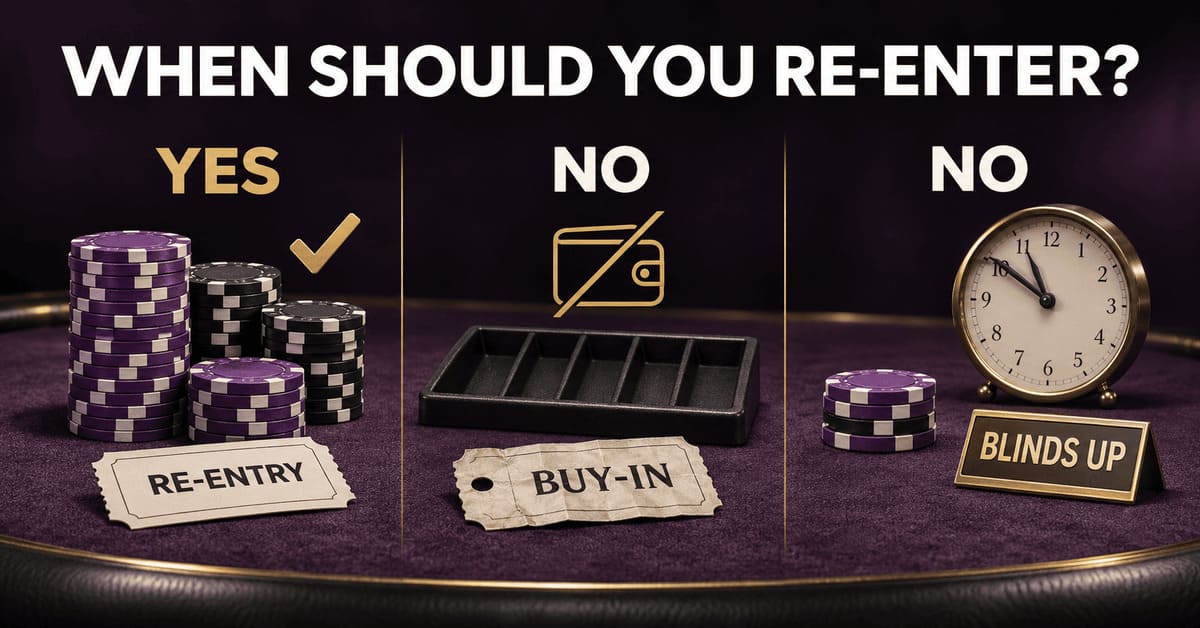
Example 1: A reasonable second entry. You entered a $30 + $3 event with an $80 session limit and lost your first stack. A new entry costs $33, bringing total spending to $66. Registration is open, a fresh stack offers 30 big blinds, levels last 15 minutes, and you feel composed. If you see a genuine skill edge, re-entering may make sense. No result is guaranteed.
Example 2: A good tournament, but an over-budget entry. You spent $55 on your first entry and set an $80 limit. Another $55 would bring your spending to $110. Even with an excellent structure, the answer is no. It is outside your budget.
Example 3: Money left, but a poor moment to continue. You planned for three $22 entries and have used two. The final entry fits your $66 limit. But a 20,000-chip starting stack now buys just 10 big blinds at 1,000/2,000, the levels are fast, and you are still annoyed by the last hand. Budget alone does not make this a sensible re-entry. Stop.
Are Re-Entries the Same as Rebuys?
Not quite. In re-entry poker tournaments, you are eliminated and pay for a new entry, usually receiving a fresh starting stack. In rebuy tournaments, the rules may allow you to purchase more chips during a rebuy period without making a completely new entry. Rebuys and re-entries also differ from adding chips in a cash game, where blinds usually stay fixed and chips have cash value.
Rules and cutoffs vary. Check the event lobby or structure sheet and Natural8’s tournament house rules.
The Bottom Line: Would You Buy This Entry Fresh?
One bad outcome does not demand another attempt. The most useful poker tournament advice is also the simplest: forget the urge to recover what is gone, keep the money already spent in your budget, and judge the new entry on its own merits. Sometimes the answer is yes. Quite often, the smartest move is to call it a day.
Frequently Asked Questions About Poker Tournament Re-Entries
Is It Ever Worth Re-Entering With Only 10 Big Blinds?
Sometimes, but it is a demanding spot. A 10-big-blind stack leaves limited room for normal post-flop play and often requires sound shove-or-fold decisions. The tournament format, payout structure, level length, and your skill all matter. Do not assume you are buying a useful stack simply because you receive the full starting number of chips.
Do Players Get the Same Starting Stack When They Re-Enter?
Usually, yes, but check the rules. Many re-entry tournaments give a returning player the standard starting stack, just as a first-time entrant would receive. The difference is that blinds may have risen considerably since the opening level. Some events have special re-entry rules, so verify the chip amount and conditions rather than relying on assumptions.
How Many Times Should I Re-Enter a Poker Tournament?
Decide the maximum before the session starts. There is no ideal number of entries that suits every player or event. Set a spending ceiling based on money you can afford to lose, then check whether the event permits that many entries. A larger budget does not mean you have to use every possible re-entry.
Does a Bigger Prize Pool Make Re-Entering More Attractive?
Not on its own. Large prize pools may offer bigger potential payouts, but they can come with larger fields, stronger opponents, and tournament fees. A meaningful evaluation considers the cost of entering, your prospects in the remaining field, and the payout structure. The headline guarantee is not proof that another buy-in has positive expected value.
Should I Re-Enter After Losing With a Strong Hand?
Judge the next entry, not the last hand. Losing with pocket aces or getting unlucky does not make you more likely to win on your next attempt. Nor does it mean you played badly. Review the hand later if needed, but right now ask whether the new entry meets your budget, structure, and emotional-readiness checks.
Can I Re-Enter After Late Registration Has Closed?
Generally, no. Re-entries are normally available only during the permitted registration window, and some events place additional limits on the number of attempts. An event may also close registration early under its rules. Before making plans, read the tournament lobby or speak to tournament staff in a live tournament rather than assuming the option remains available.
Is It Better to Re-Enter or Join a Different Tournament?
Compare the next two opportunities as if neither were your previous event. Another tournament might offer deeper starting stacks, slower blind levels, or a field better suited to your strengths. But switching events does not reset your session budget. If both options are poor or you are tired, you can skip both.
Does Buying More Entries Improve My Chance of Cashing?
More attempts can increase your overall chance of reaching the money, but they also increase what you spend. That does not mean they increase your expected return or make re-entry automatically sensible. Tournament results remain uncertain, even for skilled players. Treat each new entry as a fresh decision with a real cost, not a way to force a cash.

Shane C
Shane is a content writer with over 10 years of writing experience. He specializes in poker and casino games and has been chasing the ultimate poker dream and the excitement of hero calls for the last 15 years! Admittedly, he has yet to win any APT nor WSOP title, but he's not giving up!